Live Longer

Life Extension.

My personal opinion from reviewing the fasting/caloric restriction (a term I hate) research is that there really isn’t anything non-medical we can do to greatly extend our lifespan.

On the other hand, there is a LOT of things we can do to keep from ending our lives prematurely…which sadly I believe is the fate of most people living in North America.

Live to 150? Probably not yet.

Live to 100 and spend as much of those years ‘with it’ as possible…not a completely unreasonable goal.

So what can you do to avoid being like everyone else? (IE NOT cutting 15 years off your life and dying of a preventable disease)

Simple:

1. Eat Less

2. Stress Less

3. Weigh Less

Numbers 1 and 2 are easy (ESE) and pretty self explanatory.

Number 3 is where I think my next couple paragraphs may start an on-line fist fight.

So here it goes.

Most people reading this really want me to say that number 3 is all about having a low body fat percentage, and for the most part that’s true.

BUT..most people reading this also want me to say that the more muscle the better (even I want me to say that)…but….well I’m not sure.

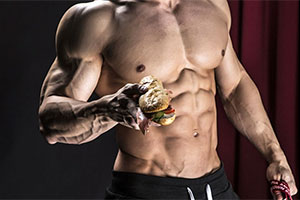
Who’s ‘more healthy’ a 5’9″ male who is 220 pounds and really over-fat, or a 5’9″ male who is 220 and 10% body fat?

I’m sure most of us think the bodybuilder is ‘more healthy’…but why?

According to the National Institute of Health:

“Overweight: Overweight specifically refers to an excessive amount of body weight that may come from muscles, bone, adipose (fat) tissue, and water.”

Not to be confused with Obesity:

Obesity: Obesity specifically refers to an excessive amount of adipose tissue.”

So why do we think that more muscle is OK?

We know there are limits to how much muscle we can carry naturally.

You simply can’t grow forever (especially without drugs).

The vast majority of us will never move far into a BMI of “overweight” just by putting on lots of muscle…

And if you did…whether through steroids, freak genetics or magic, the question remains:

Is it good for you, or do we just think it is because it “looks Healthy”?

Here’s another point about weight.

I did a lot of research on the Adonis Project, and while John Barban and Brad Howard take a light and fun approach to that product, let me assure you, there was nothing ‘light’ about the amount of research that went into it’s design.

According to those equations at 5’10″ My waist and shoulders should be:

31.5″ and 51″

Currently I’m around 32″ and 49.5″

And while I still have a bit to go on the shoulder circumference I highly doubt that my fasted weight would need to be any higher than 180 to hit this goal.

A fasted weight of 180 pounds at 5’10″ would put me just slightly into the ‘overweight” BMI. Now, I’m not a giant fan of the BMI, but my point is this:

You don’t have to weigh a lot to look great, or to be strong…

Now here’s the other point.

According to my findings in the book “How Many Calories” realistically the maximum amount of lean body mass I will probably ever be able to build is about 160 pounds. The last time I checked, my lean mass is 153 pounds (measured by BodPod) …so this is all starting to fit together.

So 7 pounds of added skeletal muscle is my limit…and probably an exaggerated one.

And I’m only about an inch away from my ideal Adonis Index (plus one on the shoulder, minus one on the waist), which from an aesthetics point of view is where an adults male body of my height should be…

Then why would anything above this be healthy?

It may not matter if it’s muscle or fat..maybe just carrying around more weight than you need to for 60 or 70 years is in and of itself, unhealthy?

Maybe the ‘muscle at all costs because it’s perfect’ mentality we’ve been sold isn’t 100% true.

In fact, just like just about everything else with health, maybe there’s a normal distribution to weight and lean mass…where anything to far to the left (too little food, too little stress, too little body weight) is just as bad as anything to the far right (too much food, too much stress, too much body weight)

But of course, this is only in the realm of health and longevity..it doesn’t mean lots of muscle is wrong or undesirable..

It all depends on your goals.

Regardless, it seems like if you want to live life as long as possible and as well as possible, for most people living in North America the answer remains:

1. Eat Less

2. Stress Less

3. Weigh Less

BP
This entry was posted by Brad Pilon on Monday, March 22nd, 2010 at 6:57 am and is filed under Weight loss

24 Comments

  1. No natural trainee will ever have to worry about getting muscular to the point where it will interfere with optimal health.

    I wrote about this here, if anyone is interested in my take on the issue:

    http://leangains.blogspot.com/2009/06/whats-my-genetic-muscular-potential.html

    Think we even discussed that article, Brad.

    People have an inflated sense of what’s attainable without drugs, much due to the cartoonish bodybuilding mags with their juiced up cover models.

  2. Steve says:

    Excellent post – definitely some food for thought…

    It’s a topic I’ve been thinking about a lot recently. Being a chiropractor I can often “guess” how much degenerative arthritis someone has before I X-ray them. I look at their posture, the way they move, their habits, history of trauma, stress levels and their weight. I definitely notice that heavier people have more degenerative arthritis (you can also call it osteoarthritis, spinal decay, wear and tear, it’s the same thing). What has surprised me over the years though, is when I see someone who works out, looks great and is carrying more weight due to more lean mass – is how often they have pretty horrible looking spines. I’m not talking huge guys either and not very old – 40s and 50s. I can think of lots of patients in the 5’10 – 6′ range weighing 180 -210 with very low body fat and unfortunately pretty advanced spinal decay. It’s sad and ironic. Here are these guys doing what they think is great for their health, only to have to stop or drastically alter their training because they’ve worn their spines and their other joints out completely.

    So I start to wonder, how much weight should our frames actually carry? How do we determine what’s healthy? That’s where something like the Adonis Index makes a lot of sense. It’s probably not just an aesthetic ideal. It’s probably a physiological ideal too. If you don’t think losing (or gaining) 20 lbs has a big impact on your frame. Put 20 lbs in a back pack and wear it around for a few minutes – then imagine the cumulative effect of that weight over 10 or 20 years. It’s huge.

  3. Brad Pilon says:

    Hey Martin

    Good to hear from you! Yeah, If I recall, our equations were typically withing a couple pounds of each other at most heights.

    Until we (not you and I, but society) admit to the degree of anabolic drug use, I fear we will always have 220 pound 5’10 guys thinking that once they cut down to 200 they’ll be ‘ripped’

    B

  4. Brad Pilon says:

    Great point steve…weight is weight…

    When I did my experiment of wearing the 40 pound weight vest for a day, my body didn’t know if it was weigh vest, fat or muscle, it just new it sucked.

    My apologies to all the pregnant women out there…carrying that much weight around just hurts.

    B

  5. James Atkinson says:

    I’ve always wondered something similar since i tend to over analyze stuff, plus since i’m 6’3″ i’m a little paranoid. Basically i’ve thought about whether larger people no matter how muscular they are, do they live as long as smaller people. One reason is because larger dog breeds tend not to live as long, and there has also been several famous powerlifters and strongman competitors that i’m aware of that have passed away over the last 17 years at a pretty young age, and that while being quite heavy, they’ve been relatively lean. My thought was that the internal organs weren’t meant to handle that much mass even if it is muscle. My only problem with my theory when it comes to these particular individuals i mentioned, is the fact that they weren’t natural athletes, so you can’t help but think that the steroids and other things they might have been taking was what actually killed them

  6. Sara says:

    I find Steve’s comment interesting and wanted to add my own take on it. I used to carry a lot of muscle and was working with fairy heavy weights four days a week. For the last year of that training regime I was always in pain – my neck, lower back, hips, knees, all of my joints ached. Eventually my right hip got so bad that I had a bunch of scans on it that confirmed osteoarthritis. I am only 38 years old!

    After having a rather serious think about the possibility of entering middle age in a substandard state I changed my whole approach to a ‘less is more’ approach. Less food, less crap in my diet (I’m on an anti-inflammatory diet and supplement regime), less weight when I’m training and less weight on my body. I’m now about 10lbs (5kg, so that’s just over 10lbs) lighter and have virtually no pain. For example, every morning just lifting my head off the pillow would cause me a lot of pain in my neck. Now I don’t think about it, it does not hurt. Getting dressed used to hurt because lifting my leg was very painful, now I don’t feel it at all.

    So.. to throw a spanner in the works, I’m not sure that heavy resistance training and carrying a lot of muscle is always the best idea, especially for a small woman like me. I have less muscle now (no bulging biceps like I used to have) but also no joint pain. Also, I know it is not supposed to happen, but I’m sure my arthritis has improved. I will never compete in a figure comp again, but I may make it to my ‘golden years’ without a zimmer frame!

    Keep up the good work Brad. Nearly every time I read something you write I find myself nodding my head and mentally high-fiving you for just stating the obvious. ;)

  7. Sara says:

    Um.. I meant to say ‘fairly heavy weights’ not ‘fairy heavy weights’. My ‘l’ is a bit sticky LOL.

  8. I think it is a combination of factors – magazine covers, unrealistic self image or being unable to see how you really look (as opposed to how you look in the mirror to yourself). I remember some articles in t-nation back in the day said you had to gain so many more pounds in order to gain in your arms etc… And where does the weight gain end?

    I believe the BMI [which was havily slammed on t-nation!} actually does give a realistic lower and upper limits for a natural weight, even if you build up your body up to the genetic limit.

    The reality is men can get away with being overweight much easier than women - clothes hide this better. If a women wants to look 'hot' - she can't hide the fact that she is 25lbs overweight. But a man can just dress in loose clothes and look at least 'ok' - when in fact he is 20-30 and more lbs overweight. Heck, most people after high school are overweight all over the world.

    To put this into perspective - catch or rent an old movie - from the 50's or the 60's. Take a look how slender and lean all people are. And compare it with the faces and figures of people now... Pudgy jaws and heavy bodies...

    Old timers like Vince Gironda got it - but somehow their message got lost. Take a look at these aricles by Gironda:

    http://ironguru.com/reaching-your-bodybuilding-goal
    "...I can’t imagine why you want to weigh 180 lbs. at your height. I am 5 feet 8 ½ inches tall and I weigh 165-168 lbs..."
    [This post ties in nicely with what John and Brad have been discussing here]

    http://ironguru.com/creating-a-bodybuilding-illusion
    “…In other words, putting muscle where it counts. It’s all in my book “Unleashing the Wild ,Physique” (you can get a copy at your local library) but basically I believe in adding to shoulder width, pectoral width and lat width, while decreasing the waist and hips as much as possible. Using exercises that build overall (random) mass will not improve your appearance…”
    [This post ties in nicely with the idea of the AE]

    Yavor

  9. Andrew Lowry says:

    Thanks interesting post. Your posts and the Adonis podcasts are causing to review my goals about muscle and size.

    Your list of three reminds me of a Quirks and Quarks (CBC Radio Science program) special on the science of longevity. At the end of the program one of the scientists said when we come right down to it for North Americans to statistically live long lives they needed to go three things;
    - Don’t Smoke
    - Wear your seat belt
    - Exercise vigorously three times at week

    I guess you add a few more. Again thanks for the post.

  10. Brad Pilon says:

    Those are awesome Andrew…

    Specially number 2

    B

  11. Brad Pilon says:

    Some how I am going to find a way to use “Fairy Heavy Weights” in a sentence on this blog.

    BP

  12. Michael says:

    Great post Brad and your posts are definitely helping me redifine my ideal physique – now I am leaning more towards the “Model” type as apposed to the “Freak” type!

  13. Thomas says:

    Brad,
    I’ve noticed in a number of epidemiological studies that cover BMI and longevity, that the longest lived actually have BMI’s that are classified as overweight–sometimes even obese. In fact, I’ve seen some where the obese (with a BMI over 30) live longer than those with a BMI under 23. These figures would seem to argue against the ideas of normal bodyweight or body leanness being ideal for health (at least with age). And much evidence also argues against body metrics (waist circumference, BMI, etc) as having any relationship with longevity

    Any thoughts?

  14. Karmyn says:

    Hi Brad,

    I gained 60 lbs when I was pregnant and I remember thinking how in the world do people carry all that extra weight around every day of their lives?

    I was only that big for a short amount of time and I couldn’t take it!

  15. Brad Pilon says:

    Hi Thomas,

    I think I addressed that right in the beginning, I don’t think there is currently anything we can do to extend our lives right now, but there are things we can do to stay ‘with it’ as long as possible.

    Please remember that A) I don’t allow links to abstracts on this site and B) I don’t allow links to opinion pieces in order to back an argument.

    However, your statements are valid (the research is mixed) but I should point out that we are interested in total body of research, not just examples of either side of the argument.

  16. Cooper says:

    Brad,

    Just an observation about your numbers. I’m a fan of John Barban’s blog as well. He is currently at a fasted weight of 175 lbs but he looks much bigger than you around the shoulders, and it looks like you are leaner than him. He is also taller than you. It would seem to me that 180 lbs might even be too much for you. What do you think?

    Cooper

  17. Cooper says:

    Brad,

    I also have another question. What explains the size of natural bodybuilders? I know they’re nothing like the freaks in Flex magazine but they still look huge.

    Thanks,
    Cooper

  18. Brad Pilon says:

    Yeah, I’d agree with that…

    As I said, probably an exaggeration.

    B

  19. Brad Pilon says:

    It’s all visual.

    everyone looks bigger when they’re lean.

    People in University used to guess me at 190 when I was 170…

    It’s all illusion and having the right muscle in the right places.

    BP

    (Oh that, and different people have different definition of ‘natural’… mostly being haven’t been on long enough to be pass a test)

  20. Social comments and analytics for this post…

    This post was mentioned on Twitter by BradPilon: 3 things to do to live longer ==> http://bit.ly/9lNYb8 (you’re probably going to HATE number 3!)…

  21. Cooper says:

    Cool. Things are much easier with realistic goals!

    Your point in brackets is actually what I suspected, but it’s good to hear it from someone who knows far more about the industry than me.

  22. Joe says:

    Hi Brad, great article. I’ve noticed that some of the best athletes with great physiques are lightweights or very strong per pound of bodyweight. Example: gymnasts, Ben Johnson was only 175, although there are exceptions, Ben Johnson may not be the best example either when it comes to being natural. Anyway I am going out for college football in a couple of months and I have to put on muscle, I’m only 11l9 lbs, at 5’9. Thats not ideal even for a cornerback. I want to stay lean and healthy. I have to too, because at that position have to be agile and fast as blades. Your input would be sweet.

  23. pligg.com says:

    Brad Pilon – Can You Live Longer?…

    Nutrition – My personal opinion from reviewing the fasting/caloric restriction (a term I hate) research is that there really isn’t anything non-medical we can do to greatly extend our lifespan….

Leave a Reply